 Award: Best Capstone Project (Science & Technology)
AlertShield: Multi-Hazard Disaster Detecting Device
Development and performance evaluation of an offline, integrated flood, fire, and gas early warning system built with an Arduino Uno microcontroller to bridge disaster vulnerability in off-grid and low-income residential areas.
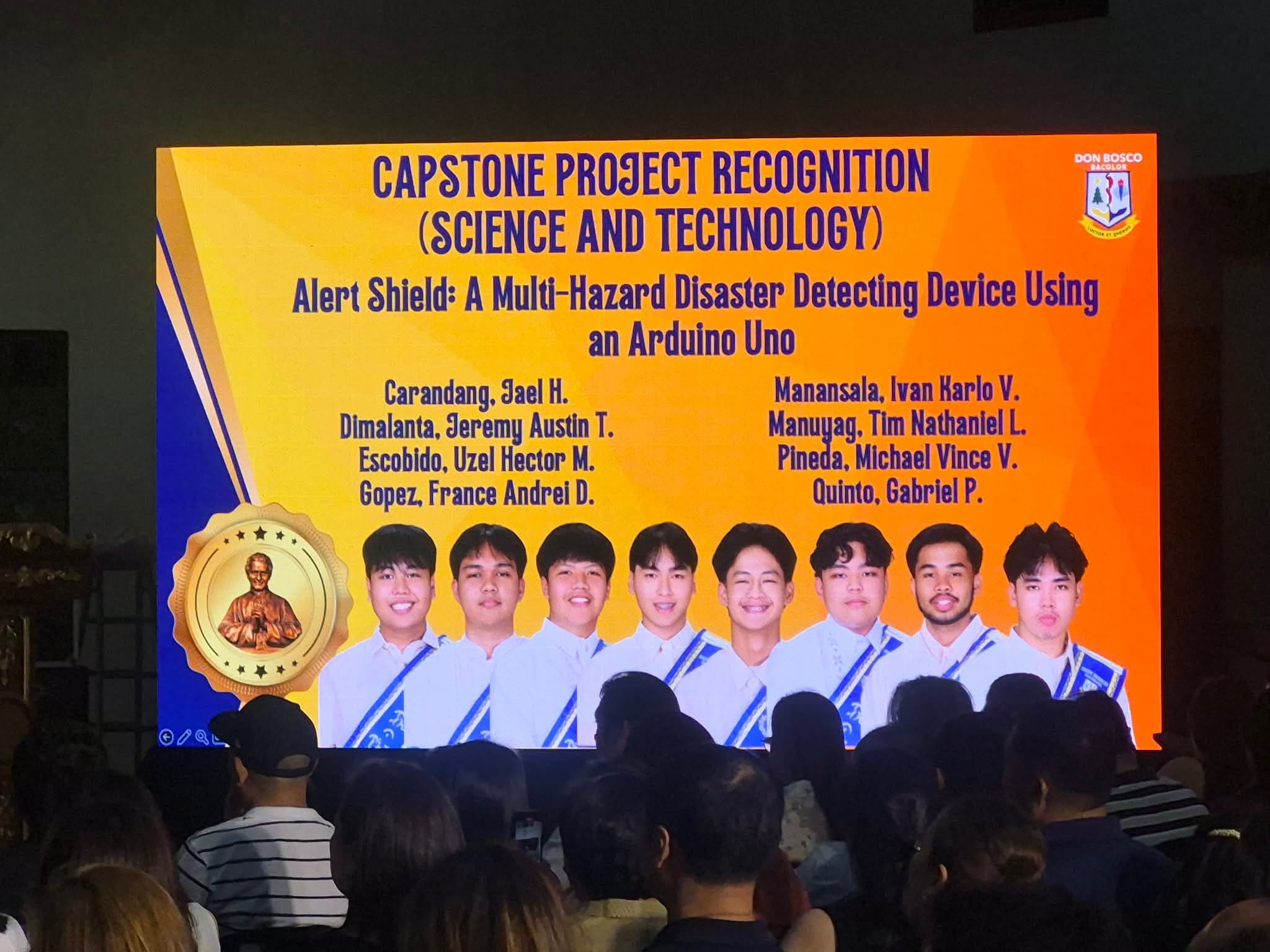
Stage presentation at Don Bosco Academy for Capstone Project Recognition in Science and Technology.
The Problem & System Philosophy
Commercial smart home detectors (such as the Google Nest Protect or industrial gas modules) create economic and functional segregation: they are prohibitively expensive for average households, require multiple discrete units, and depend entirely on stable Wi-Fi and mobile connectivity. During extreme typhoons or fires, power lines and cellular networks frequently drop first.
AlertShield is an engineering validation of a cost-effective, offline integration architecture. By executing all threshold calculations directly on bare-metal Arduino hardware, alerts trigger instantaneously without cloud latency or internet dependencies.
Multi-Hazard Sensor Array
HC-SR04 & Buoyant Pylon
Housed in a 2-inch vertical PVC conduit using a buoyant celluloid float. Acoustic time-of-flight measures water elevation mapped to PAGASA Low (15 cm) and Moderate (30 cm) warning levels.
MLX90614 Infrared
Non-contact thermopile infrared sensor calibrated strictly to the NFPA 72 residential ordinary threshold (>57°C) to eliminate false triggers caused by tropical Philippine ambient heat.
MQ-2 & MQ-7 Array
Metal-oxide semiconductor sensors detecting LPG, methane, and carbon monoxide leaks calibrated to NFPA 715 and UL 2034 10% Lower Explosive Limit (5,000 ppm) safety margins.
Empirical Performance & Evaluation
The prototype underwent 90 controlled experimental trials (30 per hazard vector) validated using paired statistical testing (Paired Samples T-Test and Wilcoxon Signed-Rank Tests):
| Hazard Vector | AlertShield Metric | Commercial Benchmark | Statistical Outcome |
|---|---|---|---|
| Heat / Fire Tracking | 141.0°C mean | 142.0°C mean | p = 0.343 (No significant difference) |
| Gas Leak Speed | 1.01 s avg response | 1.11 s avg response | 0.135s faster than commercial (p = 0.036) |
| Flood Ingress | 21.4 cm mean | 19.8 cm (Ruler) | 2.5 cm mean offset (Float geometry) |
| Alarm Trigger Rate | 100% (90/90 trials) | Synchronous sound & visual | Zero failure across all vectors |
Mechanical Housing & Fabrication
The hardware is enclosed in a custom CAD-modeled chassis manufactured via Fused Deposition Modeling (FDM) 3D printing using Polylactic Acid (PLA) thermoplastic. The enclosure provides dedicated apertures for the 16x2 I2C Liquid Crystal Display, targeted mounting slots for the MLX90614 infrared sentinel, internal circuit stabilization pillars, and mounting points for the DC piezoceramic audio alarm and status LED indicators.